A Priory Revealed
by Lionel Green
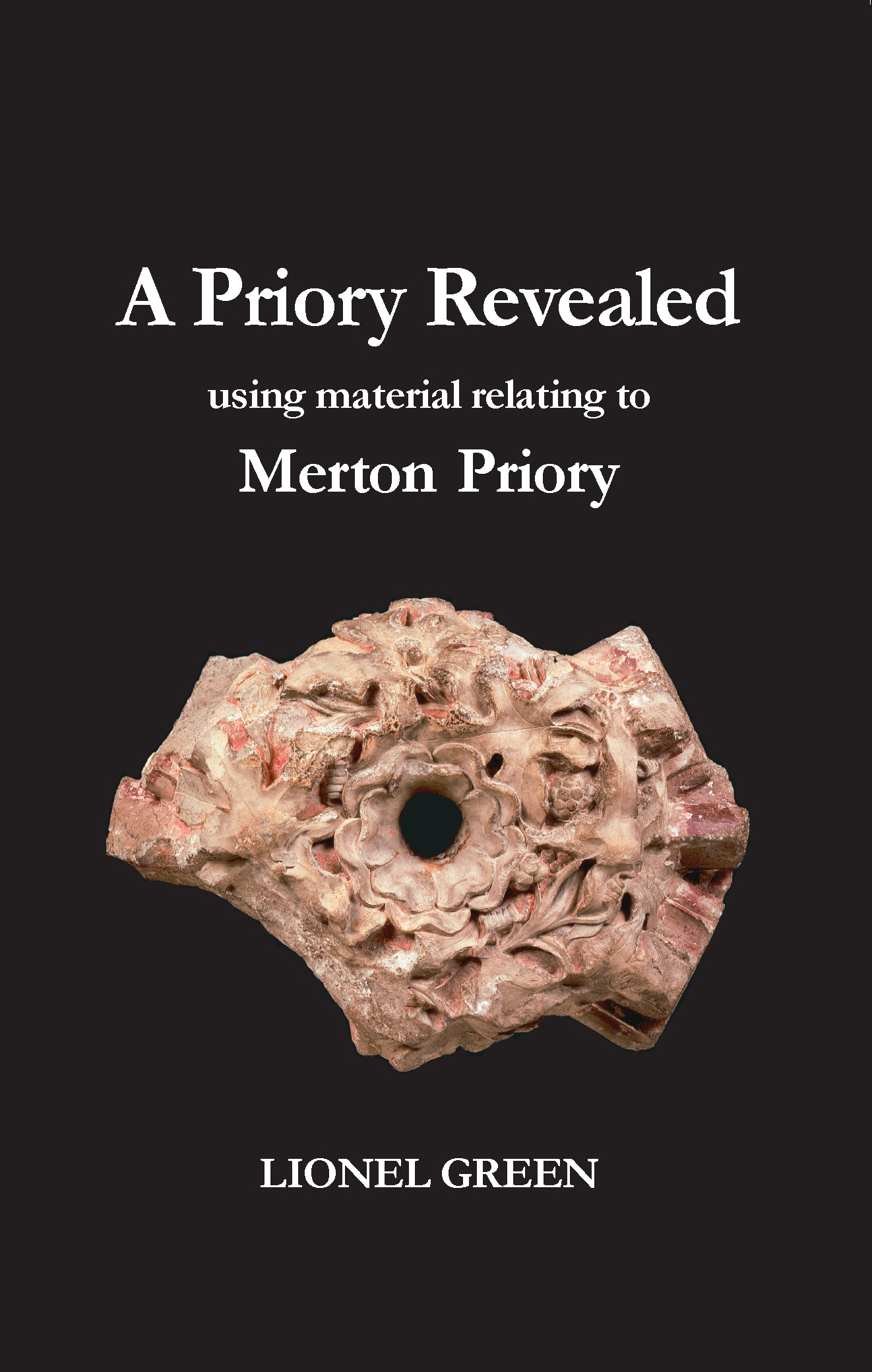
A Priory Revealed, which bears the subtitle - 'using material relating to Merton Priory' - draws upon a wide range of primary and secondary sources in order to describe, in a most accessible way, the organisation and life of not only Merton Priory, but Augustinian houses elsewhere in the British Isles. However, the focus of attention throughout the book is always on Merton, its buildings; its life; its organisation; its personalities; and the important part played by the priory on the national stage during the Middle Ages.
Surprisingly, but very successfully, Lionel begins with a 'prologue' describing in lively detail the demolition of the priory church and conventual buildings in 1538, following the surrender of the house to Henry VIII's commissioners. These scenes of destruction are followed by an introduction that takes the reader back to the origins of the monastic idea in the early years of the 4th century AD. The story is continued with the foundation of the Augustinian order in the 5th century; its eventual introduction into England; and the foundation by Gilbert the Norman in 1114 of an Augustinian community at Merton. The first two chapters recount what is known about Gilbert, and subsequent chapters cover such subjects as the priory precinct and its buildings; the Augustinian canons; the office of the prior; the educational role of the priory; the monastic day; the internal administration of the priory; the administration of the granges; and the surrender of the priory. Each of the sections, although quite short, is packed with detailed information, nearly every statement being backed by a reference to its source, necessitating the use of no fewer than 350 footnotes. The comprehensive index is also an important feature of the book.
A Priory Revealed is very well illustrated, with more than 60 photographs, maps, and line drawings. The definition of most of the photographs, both early and recent, is remarkable, given that they are printed on the same paper as the text. This is an excellent book of which the author and everyone else concerned can be proud.
(extracted from a review by John Pile published in Merton Historical Society Bulletin 157 - March 2006)
Order Form